

5 Leadership Messages That Build Stability and Performance

Athena Williams • March 22, 2026

Share this article

A CEO we work with recently led his company through a major restructuring. The strategy was strong, the financials were clear, and the leadership team had aligned on the path forward. Yet within a few weeks, he began noticing something unexpected. Teams were slowing down. Decisions were getting escalated unnecessarily. People were second-guessing priorities that had already been agreed upon.

In a coaching conversation, he said something that many executives quietly believe: “I assumed everyone understood where we were going.” What we discovered together was simple but powerful. His leadership team did understand the strategy, but they had not heard consistent signals from him about what it meant for them. Once he began deliberately reinforcing a few key messages, where the organization was headed, what mattered most right now, and that he trusted his leaders to move forward, the shift was immediate. Decision velocity increased, collaboration improved, and the emotional tone of the leadership team stabilized.

Right now, leaders are operating in environments defined by complexity, uncertainty, and constant change. In these conditions, people listen carefully to what leaders say, but they also interpret what leaders do not say. The messages you reinforce consistently shape how safe people feel to act, decide, and innovate.

Here are five things your team would love to hear from you more often.

1. “Here is where we are going.”

Direction reduces uncertainty and allows people to move forward with confidence. When leaders consistently reinforce the destination, teams align faster, make better decisions, and stop wasting energy guessing what success looks like.

2. “Here is what matters most right now.”

In complex environments, the greatest leadership gift you can offer is prioritization. When you clearly signal what deserves focus, you reduce noise, sharpen execution, and help your team invest energy where it will actually move the organization forward.

3. “I trust you.”

Trust expands ownership. When leaders signal confidence in their team’s judgment and capability, people step forward, take initiative, and bring more creativity and accountability to their work.

4. “It is safe to surface concerns.”

The quality of leadership decisions depends on the quality of information leaders receive. When people feel safe to raise concerns, challenge assumptions, and surface risks early, organizations avoid costly blind spots and make smarter decisions.

5. “I see your effort.”

Recognition regulates stress and reinforces commitment during demanding periods. When leaders acknowledge effort, not just outcomes, it strengthens morale and encourages the resilience required to navigate complexity.

Many leaders believe their teams already know these things. They assume people understand the direction, feel trusted, know what matters, and believe their effort is recognized.

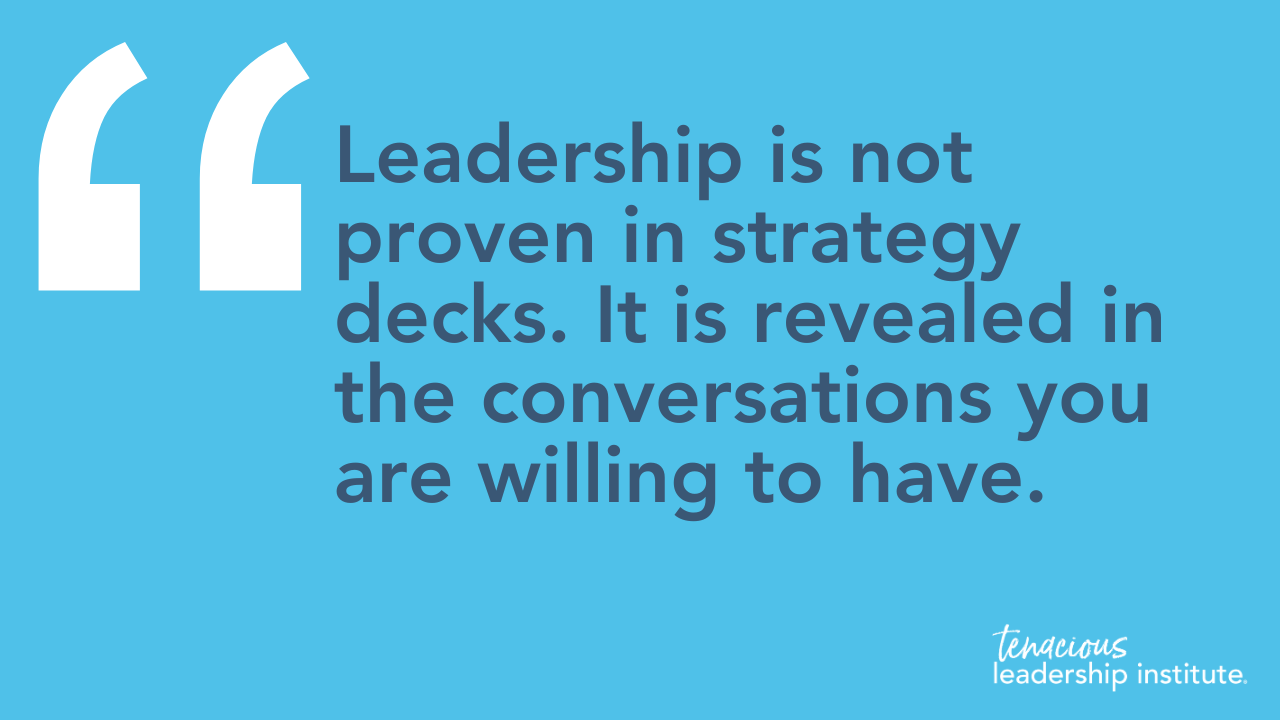
But leadership is not measured by what you assume people understand. It is measured by what you deliberately reinforce.

In periods of disruption and pressure, your team listens closely for signals from you. If they do not hear clarity, they will fill the silence with doubt. If they do not hear trust, they will hesitate. If they do not hear recognition, they will quietly disengage.

This week, choose one of these messages and say it directly to your team.

Not in a strategy document. Not in a slide deck.
In a conversation.

Because the leaders who shape strong organizations are not simply the ones with the best strategy. They are the ones who consistently send the signals that allow people to perform at their best.

Build Innovation Capacity in 10 Minutes a Day

If you want a structured way to embed innovation without overwhelming your already full schedule, we invite you to join our 30 Day Program: Innovate for Growth.

Designed specifically for senior leaders, this program delivers:

  • One short daily audio

  • One focused action

  • One reflection question

In under 10 minutes a day, you build the mindset, behaviors, and systems that sustain innovation, even during disruption.

It is practical. Neuroscience-informed. Built for executives.

If you are ready to innovate without burning out, this is your next step.

Leadership Practice

The Message Your Team Needs Most

Take five minutes this week and ask yourself a simple but powerful question:

Which of these messages might my team need to hear more clearly from me right now?

Many leaders assume these signals are already understood. But in reality, teams often operate on interpretation rather than clarity, especially during periods of pressure or change.

Choose one of the five messages and reinforce it deliberately this week. You might say it in your next leadership team meeting, in a one-on-one conversation, or in a short note to your team.

Then pay attention to what happens.

When leaders send clear signals about direction, priorities, trust, safety, and recognition, something important shifts. People stop guessing and start contributing. Energy moves from uncertainty to execution.

Sometimes the most powerful leadership move is simply saying the steadying thing out loud.

Author

Athena Williams, Founder and CEO of Tenacious Leadership Institute, partners with senior leaders and organizations navigating complex transformation at scale. For more than two decades, she has supported executives at global companies including Fortune 500 and high-growth organizations to strengthen leadership capacity, accelerate transformation, and deliver results that hold under pressure.

Her work sits at the intersection of neuroscience, leadership behavior, and execution - helping leaders think clearly in complexity, lead decisively through disruption, and align teams and organizations during critical inflection points. Through executive coaching and leadership development programs, Athena supports transformation that shows up in stronger decisions, sharper execution, and sustained performance across people, teams, and the enterprise.

Take the next step in strengthening how you lead transformation.

Recent Posts

Business meeting in a glass-walled office, with a woman speaking to seated colleagues.
By Athena Williams • October 15, 2026
Transformation creates an interesting tension for leaders. As the pace and complexity of transformation increase, we tend to focus on what the organization needs to do differently: new strategies, structures, technologies, operating models, priorities. But there is another question that matters just as much: Are you building the leadership capacity required to lead what you are creating? We think of this as the acceleration gap: the distance between the ambition and pace of transformation and the leadership capacity available to make it happen. It is a gap that rarely appears in the transformation plan or budget, yet it can become very expensive in execution. And because it isn't always recognized as a leadership capacity issue, its symptoms are often attributed to something else: resistance, slow execution, competing priorities, poor decisions, or individual leaders who appear to be struggling. But transformation doesn't just ask more of the organization. It asks more of its leaders. More ability to navigate uncertainty. More strategic thinking. Faster decisions. Greater adaptability. More capacity to align people around priorities while continuing to deliver today. And when that capacity doesn't grow alongside the demands of transformation, the gap eventually becomes visible. Here are three places to look:

By Athena Williams • October 10, 2026
Every transformation creates new demands on the people expected to lead it. We spend significant time planning what needs to change, the strategy, technology, structure, operating model and ways of working. But we spend far less time asking whether leaders are ready for what those changes will require of them.

Colleagues meeting around a laptop in a bright office conference room, discussing documents and notes.
By Athena Williams • October 3, 2026
Most successful leaders have a playbook. You’ve built it over years of experience. You know how to make decisions, mobilize people, solve problems, deliver results and navigate pressure. That playbook is part of what got you here. But transformation has a way of changing the game. The environment becomes more complex. Decisions become more interconnected. The number of stakeholders increases. Teams are expected to deliver today's results while simultaneously building something that may look very different tomorrow.

Two colleagues walking through a modern office hallway, talking as coworkers in glass meeting rooms work nearby
By Athena Williams • September 26, 2026
By the time you reach the final quarter of the year, your team has already lived a lot of life together. Priorities have shifted. Plans have changed. Some goals have been achieved, others have quietly slipped. There may have been reorganizations, new leaders, departures, launches, disappointments and more than a few things nobody anticipated back in January. And yet this is often the moment leaders ask their teams to push harder.

Team collaborating at a computer in a modern office, focused on a screen.
By Athena Williams • September 19, 2026
For decades, organizations prized specialists. Then came the idea of the T-shaped employee: deep expertise in one discipline, represented by the vertical line of the T, combined with enough breadth across other disciplines to collaborate effectively, represented by the horizontal line. The emerging idea of the X-shaped employee, recently discussed by Shopify COO Jess Hertz, takes this further. An X-shaped person doesn't simply possess expertise and breadth. They can cross boundaries, connect disciplines, work effectively with other experts and contribute beyond the confines of their own role. And I think this idea becomes even more important when we apply it to leadership.

Team meeting in a glass office, with a woman speaking to seated colleagues.
By Athena Williams • September 12, 2026
Hope may not appear on your transformation roadmap, but perhaps it should. Transformation depends on people being willing to invest effort today in a future they cannot yet fully see. When people stop believing that the future is possible, transformation can quickly become another initiative to survive rather than something they are actively helping to create. And this applies to you, too. Senior leaders are often expected to carry confidence for everyone else while privately navigating their own uncertainty, frustration and fatigue. Holding onto hope doesn’t mean convincing yourself everything will work out exactly as planned. It means maintaining a grounded belief that something better is still possible, and continuing to lead toward it.
Person on a video call at a desk, viewing multiple participants on a computer screen.
By Athena Williams • September 5, 2026
Resistance during transformation rarely announces itself with, “I don’t support this.” More often, it hides in plain sight. People agree in the meeting, then continue operating exactly as they did before. Decisions get revisited. New processes are adopted inconsistently. Leaders say they support the transformation while continuing to reward old behaviors. Teams ask for more clarity when what they may really need is greater confidence, capability, or trust.

Two professionals standing with arms crossed in a modern office, smiling at the camera
By Athena Williams • August 29, 2026
One of the great paradoxes of transformation is that leaders must create urgency while also having the patience to build something that lasts. Executives are rewarded for moving quickly. You make decisions, solve problems, push through barriers and expect progress. During transformation, those instincts are valuable, until speed becomes the measure of success.

People in a glass-walled conference room discussing around a table in a modern office
By Athena Williams • August 21, 2026
One of the greatest risks in transformation is not that your organization will resist change. It is that everyone will agree to change, and still never transform. We see this with senior leadership teams all the time. There is a bold ambition at the beginning, a new strategy, operating model, organizational structure, technology platform, customer experience or way of working. Leaders talk about doing things differently. Then the machinery of the organization kicks in.

Man working at a laptop in a modern office, with a notebook beside him.
By Athena Williams • August 15, 2026
When transformation gets difficult, even experienced leaders can fall back on what made them successful in the first place: expertise. You see the problem, you know what should happen, so you step in. That can work beautifully in the short term. But if you become the person everyone depends upon for direction, decisions and problem solving, you may inadvertently create the very thing transformation cannot afford: organizational dependency on you.

Show More