

The Hidden Cost of Insisting as a Leader

Athena Williams • May 16, 2026

Share this article

Businessman in a suit speaking animatedly during a laptop video meeting in a glass office

Most executives do not wake up intending to create resistance on their teams.

In fact, many leaders who become overly insistent are highly committed, hardworking, and deeply invested in organizational success. They care about quality. They care about results. They care about moving things forward.

But during periods of pressure, uncertainty, and complexity, even strong leadership can unintentionally shift from clear intention into insistence.

And teams feel the difference immediately.

Intending means being strongly committed to an outcome while remaining open to dialogue, adaptation, timing, and shared ownership.

Insisting happens when leaders become emotionally attached to a specific answer, path, pace, or response, often creating pressure that others experience as control.

This distinction matters more than ever right now because many people are already operating under elevated stress loads. Research in neuroscience and organizational psychology suggests that when individuals perceive excessive pressure or reduced autonomy, the brain often moves into defensive states rather than collaborative or innovative thinking.

Ironically, the harder leaders push, the more resistance they often create.

The challenge with insistence is that it can temporarily look effective. Decisions get made quickly, conversations move faster, and teams often comply in the short term. From the outside, it can appear that the leader is creating momentum and driving accountability. But beneath the surface, a very different dynamic can begin unfolding.

People stop raising concerns openly, innovation decreases, psychological safety weakens, and leaders start receiving filtered information instead of honest insight. Ownership can quietly decline as teams shift from genuine engagement into managing the emotional pressure of the environment.

Over time, insistence creates organizational fatigue. Teams may continue saying “yes” externally while internally disengaging, withholding ideas, avoiding risk, or limiting contribution. Collaboration becomes more performative than authentic, and resentment can quietly build beneath the surface.

This is one reason leadership teams sometimes struggle despite having highly capable people. The issue is not always strategy, intelligence, or effort. Sometimes the environment has become too emotionally compressed for healthy disagreement, creativity, and shared problem-solving to occur.

Three Signs You May Be Moving Into Insistence

1. You Are Seeking Agreement More Than Insight

You continue asking questions, but internally you have already decided what the answer should be. The conversation subtly shifts from exploration into persuasion. Teams can often sense this quickly. What initially appears to be collaboration starts feeling like a process of leading people toward a predetermined conclusion rather than genuinely inviting perspective or challenge.

From a neuroscience perspective, people are highly attuned to cues of psychological safety and autonomy during conversations. Research on threat responses in the brain suggests that when individuals feel their voice or influence is limited, the nervous system can move into protective behaviors such as withdrawal, compliance, defensiveness, or reduced creativity. Executives often do not realize that the issue is not simply what they are asking, but whether others genuinely believe their input can shape the outcome.

2. People Become Quieter Around You

One of the clearest signs of insistence is reduced openness from others. Teams become more cautious, overly agreeable, or hesitant to challenge ideas. This is particularly dangerous for executives because silence is often mistaken for alignment when it may actually reflect disengagement, fear of conflict, or emotional fatigue.

One executive coaching client recently shared: “I thought my team was aligned because meetings were moving faster and there was less debate. What I eventually realized was they had stopped believing it was safe or useful to challenge me.” That insight became a turning point in how they led conversations. As they shifted from pushing for immediate agreement toward creating more openness and curiosity, the quality of dialogue, innovation, and ownership across the team improved significantly.

3. You Feel Increasing Frustration When Others Do Not Move Fast Enough

Insistence often intensifies when leaders feel pressure themselves. The tighter the timeline or higher the stakes, the stronger the impulse becomes to push harder. But pressure rarely expands human performance for long. More often, it narrows thinking, reduces ownership, and creates reactive behavior rather than thoughtful execution.

Research from organizational psychology and leadership studies has consistently shown that excessive pressure and controlling leadership behaviors reduce intrinsic motivation, learning, and adaptive problem-solving over time. While urgency is sometimes necessary, people tend to perform at their highest level when they experience both clear expectations and a sense of agency in how they contribute. Leaders who understand this distinction are often able to create stronger accountability and faster execution without generating the resistance that insistence frequently produces.

What Strong Leadership Looks Like Instead

Strong leadership is not passive. It still requires clarity, standards, accountability, decisiveness, and strategic direction. But the strongest leaders understand that there is a difference between creating direction and creating pressure. They know how to hold a clear vision while remaining flexible enough to listen, adapt, and bring others into meaningful ownership of the work. Especially during uncertainty, leadership effectiveness is not just about what a leader says or decides. It is about the emotional and relational environment they create around those decisions.

Leaders who create sustainable results consistently do three things well:

  • communicate expectations clearly while remaining open to perspective and challenge
  • regulate their own emotional intensity instead of transferring stress onto the organization
  • create environments where people can think critically, contribute honestly, and take ownership

This is one reason executive coaching has become increasingly important for senior leaders. Many executives have developed exceptional strategic capability, but have never been taught how their nervous system, emotional patterns, and communication style shape organizational behavior under pressure.

The leaders creating the strongest cultures and outcomes right now are often not the most forceful or controlling. They are the ones who know how to create movement, accountability, and transformation without overpowering the people around them.

Executive Coaching for Leaders Navigating Complexity and Change

Today’s executives are expected to create alignment, drive performance, lead transformation, and maintain trust, often while operating under intense pressure themselves.

Our Executive Coaching programs help leaders strengthen influence, communicate more effectively during uncertainty, increase strategic leadership capacity, and create organizational movement without generating unnecessary resistance or burnout.

Using neuroscience-informed leadership development, practical execution frameworks, and two decades of experience supporting senior leaders globally, we help executives elevate both leadership effectiveness and organizational impact.

If you are ready to strengthen how you lead through complexity and change, we would love to support you.

Leadership Practice

Identify One Area of Leadership Insistence

This week, identify one leadership situation where you are experiencing resistance, frustration, or slower-than-expected progress.

Then reflect on the following questions:

  • What outcome am I truly intending?
  • Where might I be creating unnecessary pressure?
  • How could my communication or emotional tone be impacting others?
  • What would it look like to hold strong standards while creating more ownership?
  • Where do I need more openness instead of more control?

Often the fastest way to reduce resistance is not lowering expectations.

It is reducing unnecessary insistence.

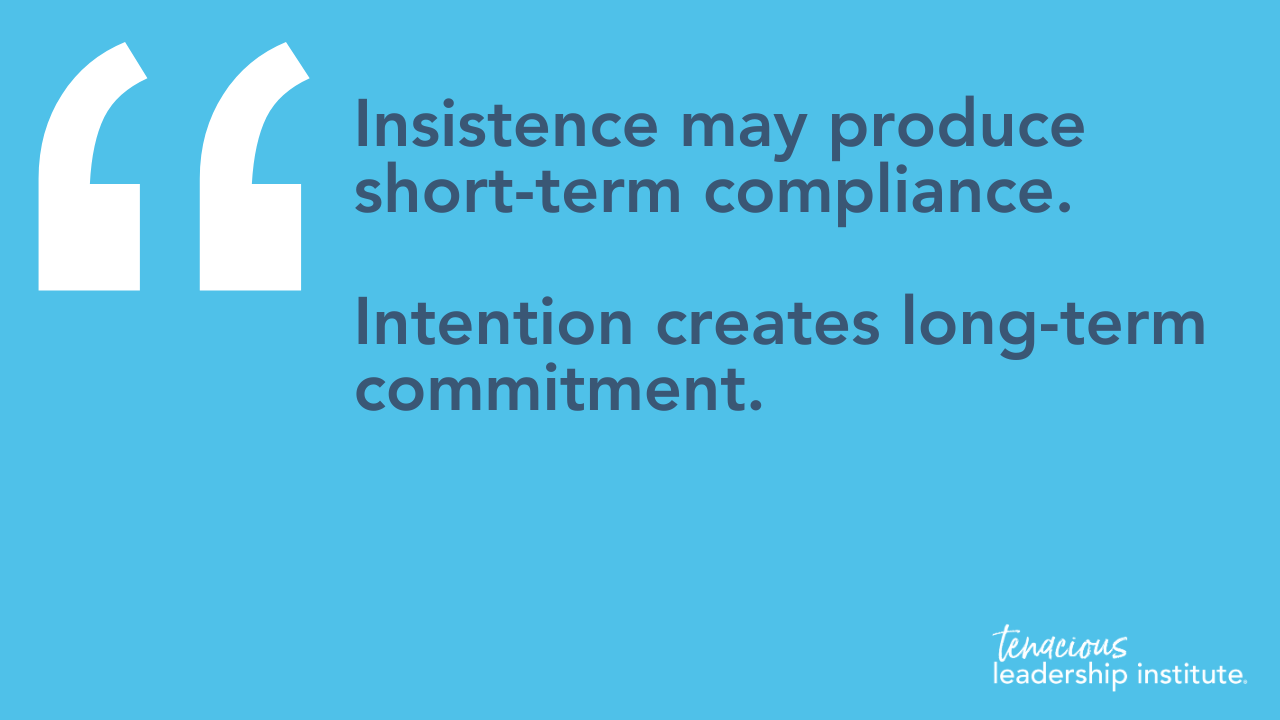
Blue quote graphic: “Insistence may produce short-term compliance. Intention creates long-term commitment.”

Author

Athena Williams, Founder and CEO of Tenacious Leadership Institute, partners with senior leaders and organizations navigating complex transformation at scale. For more than two decades, she has supported executives at global companies including Fortune 500 and high-growth organizations to strengthen leadership capacity, accelerate transformation, and deliver results that hold under pressure.

Her work sits at the intersection of neuroscience, leadership behavior, and execution - helping leaders think clearly in complexity, lead decisively through disruption, and align teams and organizations during critical inflection points. Through executive coaching and leadership development programs, Athena supports transformation that shows up in stronger decisions, sharper execution, and sustained performance across people, teams, and the enterprise.

Take the next step in strengthening how you lead transformation.

Recent Posts

Business meeting in a glass-walled office, with a woman speaking to seated colleagues.
By Athena Williams • October 15, 2026
Transformation creates an interesting tension for leaders. As the pace and complexity of transformation increase, we tend to focus on what the organization needs to do differently: new strategies, structures, technologies, operating models, priorities. But there is another question that matters just as much: Are you building the leadership capacity required to lead what you are creating? We think of this as the acceleration gap: the distance between the ambition and pace of transformation and the leadership capacity available to make it happen. It is a gap that rarely appears in the transformation plan or budget, yet it can become very expensive in execution. And because it isn't always recognized as a leadership capacity issue, its symptoms are often attributed to something else: resistance, slow execution, competing priorities, poor decisions, or individual leaders who appear to be struggling. But transformation doesn't just ask more of the organization. It asks more of its leaders. More ability to navigate uncertainty. More strategic thinking. Faster decisions. Greater adaptability. More capacity to align people around priorities while continuing to deliver today. And when that capacity doesn't grow alongside the demands of transformation, the gap eventually becomes visible. Here are three places to look:

Colleagues meeting around a laptop in a bright office conference room, discussing documents and notes.
By Athena Williams • October 3, 2026
Most successful leaders have a playbook. You’ve built it over years of experience. You know how to make decisions, mobilize people, solve problems, deliver results and navigate pressure. That playbook is part of what got you here. But transformation has a way of changing the game. The environment becomes more complex. Decisions become more interconnected. The number of stakeholders increases. Teams are expected to deliver today's results while simultaneously building something that may look very different tomorrow.

Two colleagues walking through a modern office hallway, talking as coworkers in glass meeting rooms work nearby
By Athena Williams • September 26, 2026
By the time you reach the final quarter of the year, your team has already lived a lot of life together. Priorities have shifted. Plans have changed. Some goals have been achieved, others have quietly slipped. There may have been reorganizations, new leaders, departures, launches, disappointments and more than a few things nobody anticipated back in January. And yet this is often the moment leaders ask their teams to push harder.

Team collaborating at a computer in a modern office, focused on a screen.
By Athena Williams • September 19, 2026
For decades, organizations prized specialists. Then came the idea of the T-shaped employee: deep expertise in one discipline, represented by the vertical line of the T, combined with enough breadth across other disciplines to collaborate effectively, represented by the horizontal line. The emerging idea of the X-shaped employee, recently discussed by Shopify COO Jess Hertz, takes this further. An X-shaped person doesn't simply possess expertise and breadth. They can cross boundaries, connect disciplines, work effectively with other experts and contribute beyond the confines of their own role. And I think this idea becomes even more important when we apply it to leadership.

Team meeting in a glass office, with a woman speaking to seated colleagues.
By Athena Williams • September 12, 2026
Hope may not appear on your transformation roadmap, but perhaps it should. Transformation depends on people being willing to invest effort today in a future they cannot yet fully see. When people stop believing that the future is possible, transformation can quickly become another initiative to survive rather than something they are actively helping to create. And this applies to you, too. Senior leaders are often expected to carry confidence for everyone else while privately navigating their own uncertainty, frustration and fatigue. Holding onto hope doesn’t mean convincing yourself everything will work out exactly as planned. It means maintaining a grounded belief that something better is still possible, and continuing to lead toward it.
Person on a video call at a desk, viewing multiple participants on a computer screen.
By Athena Williams • September 5, 2026
Resistance during transformation rarely announces itself with, “I don’t support this.” More often, it hides in plain sight. People agree in the meeting, then continue operating exactly as they did before. Decisions get revisited. New processes are adopted inconsistently. Leaders say they support the transformation while continuing to reward old behaviors. Teams ask for more clarity when what they may really need is greater confidence, capability, or trust.

Two professionals standing with arms crossed in a modern office, smiling at the camera
By Athena Williams • August 29, 2026
One of the great paradoxes of transformation is that leaders must create urgency while also having the patience to build something that lasts. Executives are rewarded for moving quickly. You make decisions, solve problems, push through barriers and expect progress. During transformation, those instincts are valuable, until speed becomes the measure of success.

People in a glass-walled conference room discussing around a table in a modern office
By Athena Williams • August 21, 2026
One of the greatest risks in transformation is not that your organization will resist change. It is that everyone will agree to change, and still never transform. We see this with senior leadership teams all the time. There is a bold ambition at the beginning, a new strategy, operating model, organizational structure, technology platform, customer experience or way of working. Leaders talk about doing things differently. Then the machinery of the organization kicks in.

Man working at a laptop in a modern office, with a notebook beside him.
By Athena Williams • August 15, 2026
When transformation gets difficult, even experienced leaders can fall back on what made them successful in the first place: expertise. You see the problem, you know what should happen, so you step in. That can work beautifully in the short term. But if you become the person everyone depends upon for direction, decisions and problem solving, you may inadvertently create the very thing transformation cannot afford: organizational dependency on you.

Two coworkers smiling and reviewing a laptop together in a modern office
By Athena Williams • August 8, 2026
Transformation demands enormous cognitive and emotional capacity. Leaders are constantly switching between today's operational realities and tomorrow's possibilities. They're making decisions with incomplete information, navigating competing priorities, responding to resistance and helping others remain focused through uncertainty. The instinct is often to keep pushing.
Show More